Home Contact Us Jobs Looking Ahead Sitemap
About Us

Focus Areas

Publications & Research Conference Reports Media Archives Links

Second International Roundtable on Constructing Peace, Deconstructing Terror

26-27 June 2005
Brussels

  • Background
  • Brussels Consensus
  • Second International Roundtable Report
  • List of Participants

Brussels Consensus

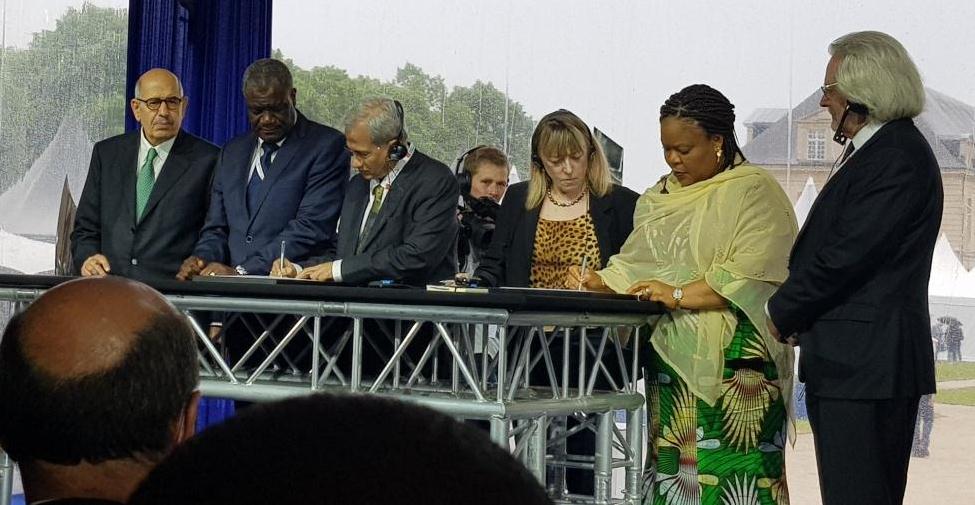
A group of 35 eminent leaders from Africa, Asia, Europe, the Middle East and North America met at the European Parliament in Brussels on the 26-27 June 2005 at the Second International Roundtable on Constructing Peace, Deconstructing Terror. Alliance of Liberals and Democrats for Europe in the European Parliament and Strategic Foresight Group in cooperation with Friedrich-Naumann-Stiftung convened the roundtable. The group considered the Delhi Declaration on Sustainable Global Security issued in June 2004. The group discussed various aspects of the threat of terror facing humanity and made the following recommendations.

Constructing peace and deconstructing terror demands a global approach. It is not appropriate to address this issue on a selective basis. It is an issue that touches the essential fabric of all societies and faiths. This issue has multiple dimensions including political, cultural, economic and psychological, and therefore it must be addressed in its entirety.

Constructing peace and deconstructing terror demands an international agreement at the highest level of political decision makers in the world. Therefore the Brussels Roundtable calls for an international summit of world leaders. Such a summit may be preceded by regional summits to discuss this issue. The Brussels Roundtable calls on the UN Secretary General to consider this call for future action. These issues could be addressed at the Millennium Plus Five Summit in September 2005 or, if necessary, be the subject of a separate later meeting.

Constructing Peace: Principles of Sustainable Global Security

The following broad principles should be adopted as necessary normative foundations for sustainable global security in the context of terror:

  • Prince of Just Means

  • Principle of Religious Sanctity

  • Principle of Human Liberty and Dignity

  • Principle of Peaceful Conflict Resolution

  • Principle of the Obligation of States

  • Principle of Common Standards

Deconstructing Terror: Policies for a Safer World

The global policy response to terror should be based on the following principles:

Zero tolerance for terrorist acts (defined for this purpose as 'any action intended to cause death or serious bodily harm to civilians or non-combatants, when the purpose of such an act, by its nature or context, is to intimidate a population, or to compel a government or an international organisation to do or to abstain from doing any act'). These should be punished as appropriate in accordance with the criminal law of the state concerned and relevant international conventions.

Recognition that groups engaged in terrorist acts have many different stated objectives and in many cases underlying motives which may not be the same as those objectives, and that in many instances there are separate root causes lying behind and explaining those objectives and motives - and that, accordingly, policy towards different groups needs to be closely tailored, case by case, to individual situations.

Willingness to embrace strategies that are much broader than reliance on coercive police and military means, namely (as expressed by the United Nations Secretary General) dissuasion of disaffected groups from choosing terrorism as a tactic to achieving goals, denial of terrorists of the means to carry out their attacks, deterrence of states from supporting terrorists, development of state capacity to prevent terrorism and defence of human rights in the struggle against terrorism.

Support for broad transformative initiatives including:

Creating adequate educational facilities worldwide, and modernizing the existing ones, not just to achieve full literacy but also to enable people to acquire skills to cope with the demands of the modern economy.

New partnerships between the state, private sector and NGOs to create employment, especially for youth and women, in fragile societies.

Genuine commitment to empower women in efforts to construct peace and deconstruct terror, and to develop policies of gender mainstreaming.

Intra - and inter-faith dialogues at various levels to promote understanding, acceptance and proper interpretation of the teaching of all religions with regards to the means to achieve justice.

Promotion of accountability, open and democratic political space and people's participation in the institutions of governance and civil society.

Capacity building of states to deal with crime and terror in effective and just ways and to resolve conflicts.

 
Copyright 2007 | All Rights Reserved www.strategicforesight.com Designed and Developed by Point 2 Point Communications