Strategic Foresight Group report on Cost of Conflict in the Middle East was presented at the United Nations Alliance of Civilizations Forum held in Istanbul on April 7. The discussion resulted in concrete ideas for a way forward:
(1) There was a consensus that the Israeli settlements in the West Bank should be frozen and check-points should be reduced. The Arab League Secretary General said that the Arab states would respond constructively if there was a credible action plan to change situation on the ground with regards to settlements and check-points.
(2) The European leaders strongly pleaded for a joint strategy by the United States and Europe to resolve the Arab-Israeli conflict. Turkey offered its good offices to facilitate dialogues for peace.
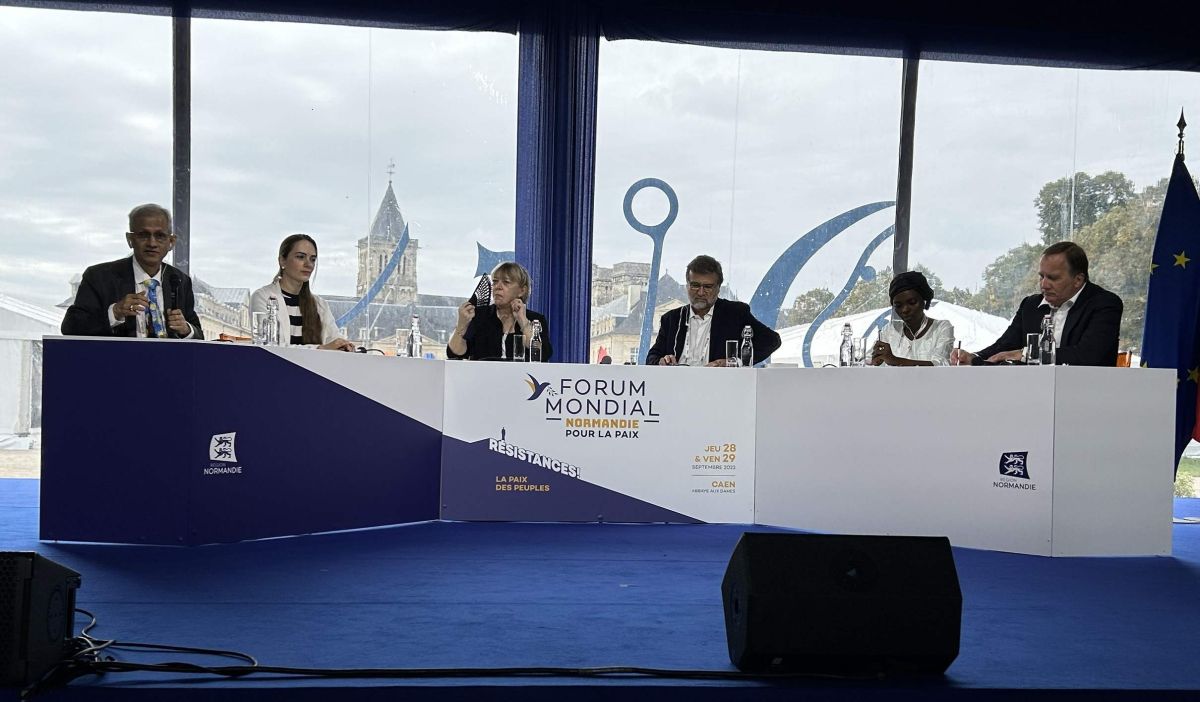
The panelists, moderated by Sundeep Waslekar, were Amre Moussa, Secretary General of the Arab League; Miguel Angel Moratinos, Foreign Minister of Spain; Jean Asselborn, Foreign Minister of Luxembourg; Egemen Bagis, EU Minister of Turkey; Jean Daniel Ruch, Switzerland's Special Envoy for the Middle East. Also present were Jorge Sampaio, UN High Representative and former President of Portugal; Kjell Magne Bondevik, former Prime Minister of Norway and Sabri Rbeihat, Culture Minister of Jordan, besides a large number of senior diplomats, politicians and civil society leaders.
Foreign Minister of Spain, Miguel Angel Moratinos said that apart from money and cost, the Middle East has lost hope for human life and it is difficult to maintain a sense of justice. The equation in the Middle East has become a lot more complex since the Madrid conference. Minister Moratinos stressed on the need to mobilize the people and find new approaches with the European, Americans and Arabs working together. He stressed on the need to act quickly and in a concerted manner. He said that embargoes and boycotts have never succeeded anywhere in the world in resolving problems and one has to find creative solutions to the conflict. He said, “I have worked with Israeli PM Netanyahu in the past. He is a hard liner, but pragmatic. We should engage with the Israeli government and see the response.”
Secretary General of the Arab League, Amre Moussa thanked the Strategic Foresight Group for its report on the Cost of Conflict in the Middle East that gives figures to the losses suffered in the region. He spoke about the loss of lives, progress, hope and the loss of credibility of diplomacy around the world, including that of the International Court of Justice. Secretary General Moussa stressed on the stopping of settlements, as the changing demographic composition in the West Bank would soon make a two state solution impossible. He said that the removal of settlements would be on the road to peace.
State Minister Egemen Bagis, Turkey’s Chief Negotiator for EU Talks said that the Cost of Conflict in the Middle East served as a wake up call. He said that Turkey also supported the two state solution and was committed to being a part of the peace process. He said that the Middle East has seen many wars, but not enough diplomacy and peace processes. He spoke about Turkey’s Zero Conflict Policy with its neighbours and its commitment to peace making efforts. On engaging with peace processes he said, “we don’t have preconditions. As long as there is will on both sides, as long as Israel and Syria are there, we will be there.”
Foreign Minister of Luxembourg, Jean Asselborn spoke of the importance of bringing people together and of the basis of the Annapolis peace plan- no settlements, removal of road blocks. He said that Israel wants security, but one has to also accept the Palestinian right to dignity. He said that Syria was an important player in the region and it should be engaged.
Switzerland’s Special Envoy for the Middle East, Jean Daniel Ruch said that the SFG report has already mobilized political attention. He said that a mobilization of political will would follow by going deeper into possible solutions. He said that the most difficult cost is human suffering and that no peace process can be successful if you do not address the need for justice. There is a need to deal with the past for long term solution of the conflict. Amb. Ruch also mentioned the fact that the Arab world feels that double standards are at work when the Europeans and American deal with them. As a positive factor, he mentioned the appointment of Justice Goldstone by the UN Human Rights Council to lead a fact-finding mission to investigate international human rights and humanitarian law violations related to the recent conflict in the Gaza Strip, both in Gaza as well as in the Southern parts of Israel.
Jordan’s Minister of Culture, Sabri Rbeihat, said that the report could be used as a tool for raising consciousness and to create awareness of the huge costs that the region is paying for the conflict.
The Consul General of Israel in Turkey said that settlements were not the core issue that Israelis and Palestinians needed to solve, and that Israel had dismantled settlements before and could do so again. The only response that Israel received to the removal of settlements was terrorism. He said that the core issue was terrorism and that non-recognition of Israel by the Arab states.
The Saudi Arabian Ambassador to Turkey said that only the US can act in a way that can change the situation. He said that the issue of subsidies needs to be looked at, as agricultural subsidies in Israel lead to the stifling of agriculture in Gaza.
Taking the floor at the end, the high representative of the UN Alliance of Civilizations (AoC) Forum, former Portuguese President Jorge Sampaio said that the AoC does not have the capacity to solve problems but could help politicians to do so. He said that the AoC needs to show people that we can live in peace side by side. He expressed great happiness for SFG presenting its report at the Alliance of Civilizations
Print this Article
|